
Gripper
The first version of the gripper was designed and prototyped for a minor assignment with PD&D (Product Design & Development). The full report includes the detailed Literature review, Conceptualisation, Concept Evaluation, Design and Prototyping Phase, as well as motor choices, transmission ratios, and material selections. The report can be found in the Roboteam Twente 2025-2026 folder at the following location:
The report can also be found by clicking on the following link:
https://drive.google.com/file/d/1Wu9a8M1p-OKg_CWaNAc5rW-M6DI_p-xK/view?usp=drive_link
1. Summary & Content of report
2. Requirements
3. System Description & CAD models
Figure 1a and Figure 1b illustrate the full gripper and its subassemblies. The design is divided into three main subassemblies: the jaws’ assembly, the planetary gearbox, and the connection to the robotic arm. The design phase aimed to ensure that two gripper configurations would be possible: a two-jaw configuration and a four-jaw configuration. Both configurations use soft, compliant, reinforced jaws, actuated by a worm gearbox. The jaws’ rest position is closed, as compression springs are located under each jaw. The springs are used to minimize the motor requirements in torque and enhance the force closure.
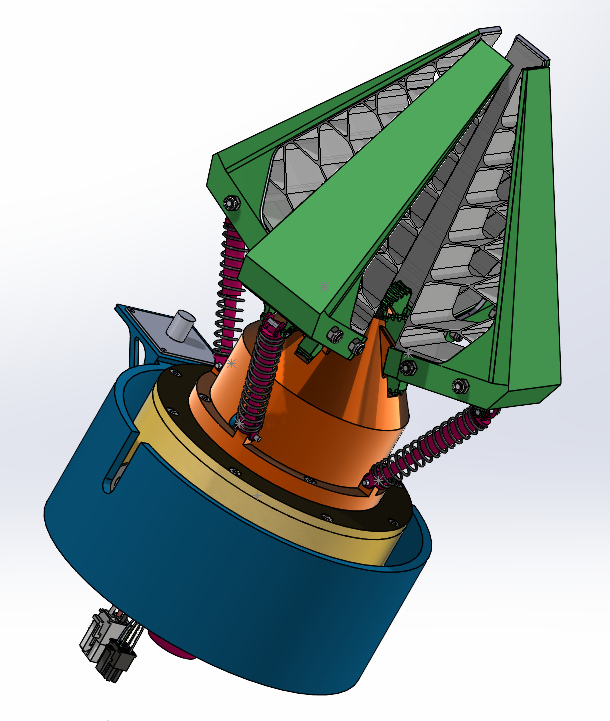
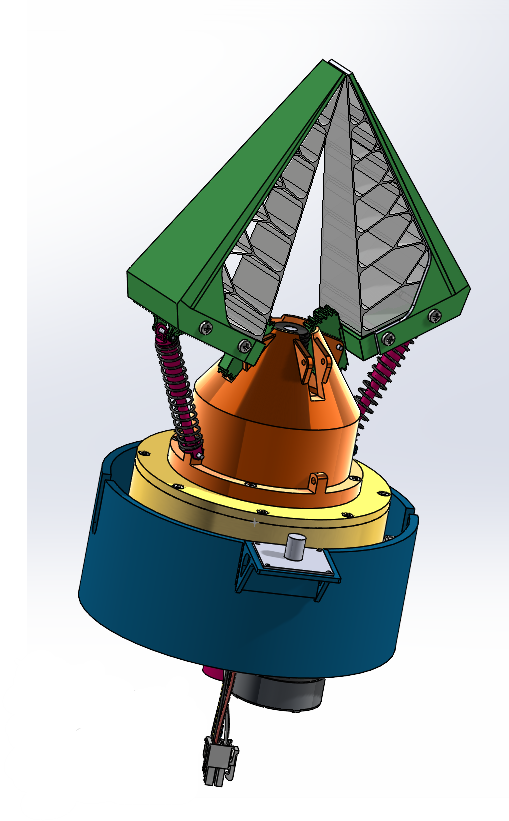
Figure 1: Full assembly of four-jaw configuration Figure 2: Full assembly of two-jaw configuration
A planetary gearbox ensures the rotation of the gripper around its centre axis. The sun gear allows for the cables of the jaws motor and force sensors to connect to the rest of the system.
The wrist pitch is actuated by a DC motor combined with a planetary gear head. The gear head is connected to a 1:1 pulley-belt drive.
Overall, the gripper makes use of three DC motors, three encoders, three motor drivers, and two force sensors. Additionally, the gripper carries a camera used for Business Logic during maintenance and sampling tasks. The video feed is sent to computer vision.